
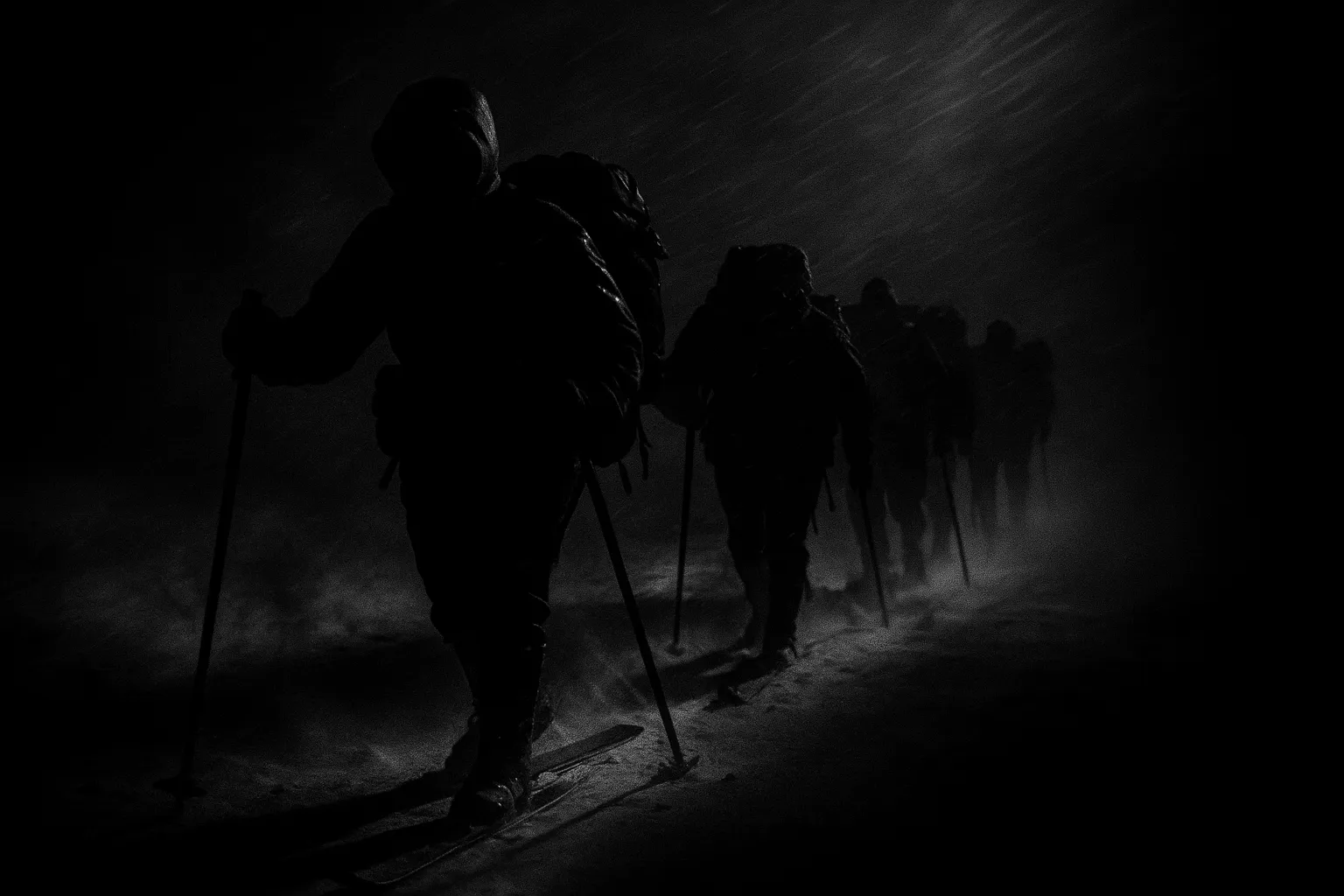
“Do not sleep on the Dead Mountain,” a Mansi elder is said to have warned. “If it hears your dream, it will finish it for you.”
- The Official Version (What the History Books Say)
- The Hidden Secret (Theories They Don’t Want You To Weave Together)
- Hunter’s Analysis
- An Open Ending
Dyatlov’s Curse: The Night the Mountain of the Dead Woke Up
They found the tent standing but sliced open from the inside. Nine hikers fled barefoot into -30°C winds, leaving neat, single-file footprints that calmly walked into the dark. Hours later, some turned up with ribs pulverized as if by a car crash—but with no external bruising. One had her tongue and eyes missing. Several had skin the color of orange rust. On pieces of clothing, investigators recorded unexpected radiation. And in the winter sky of 1959—above a mountain the Mansi people call Kholat Syakhl, “Mountain of the Dead”—locals reported silent, glowing orbs.
Are you sure you still want “the official explanation”?
The Official Version (What the History Books Say)
- Location: Kholat Syakhl (61.75°N, 59.45°E), northern Ural Mountains, then-Sverdlovsk Oblast, USSR.
- People: Nine experienced hikers from the Ural Polytechnic Institute, led by Igor Dyatlov (born 1936).
- Date: Late January to February 1959. The group left Vizhay on January 27; their last camp was pitched on February 1; the first bodies were found starting February 26.
- Scene: A 10-person canvas tent, stabilized with skis and ski poles, erected on a windswept slope around 1,079 meters elevation. Inside: boots, jackets, a stove (not yet assembled), diaries, cameras. The tent was cut from the inside. Footprints—some barefoot, some in socks—led down-slope into the forest for roughly 500 meters before snow swallowed the trail.
- Recovery: Two bodies under a cedar, near a makeshift fire, about 1.5 km from the tent. Three more along the line between tent and tree, as if crawling back. Four in a ravine ~75 meters deeper into the woods, within a collapsed snow shelter.
- Forensics: Temperatures -25°C to -30°C with strong winds. Some died of hypothermia; others sustained massive internal trauma without external wounds—rib fractures, crushed chest. Lyudmila Dubinina’s tongue and eyes were missing; several victims showed skin bronzing. Laboratory tests recorded elevated radioactivity on a few pieces of clothing, documented in 1959 case materials.
- Official outcomes: In 1959 the case closed with a vague note about “a compelling natural force.” Decades later, prosecutors revisited the case and gravitated toward a slab avalanche and related factors.
If you want the “official” record, start here:
- Dyatlov Pass incident (Wikipedia): https://en.wikipedia.org/wiki/Dyatlov_Pass_incident
- Scientific American (avalanche modeling revisited, 2021): https://www.scientificamerican.com/article/scientists-possibly-solve-famous-dyatlov-pass-mystery/
But this neat avalanche narrative leaves jagged edges that cut through certainty. The footprints are too calm; the trauma too surgical; the timing too perfect. The “official” explanation leaves threads dangling in the snow…
The Hidden Secret (Theories They Don’t Want You To Weave Together)
A mountain with a death-name. A tent cut from within by people who then walked—didn’t run—into howling cold. Trauma without blunt-force marks. Radioactivity. Orbs.
Science conventional ignores, but the pattern pulses across continents and centuries.
Military Tests and Silent Shockwaves:
The Urals in 1959 were not a blank map. Parachute mines and airburst tests can produce concussive pressure that breaks ribs and crushes chests without obvious external injuries—exactly the kind of “inside-out” trauma noted here. Such devices can also rain down glowing fragments or leave luminous phenomena in the sky. Multiple testimonies in February–March 1959 from the Ivdel and Vizhay area describe orange, silent fireballs. Would you call that “coincidence,” or choreography?The Infrasound Doorway:
Some researchers whisper about Kármán vortex streets and infrasound funneled by the slope. Infrasound can trigger panic, nausea, and an irresistible sense of dread. But why would seasoned hikers slice their own shelter rather than use the flap? Why walk single-file, barefoot, into a killing wind, then build a fire with deliberate care under a cedar? Panic makes chaos. This was ritual precision—like they were following instructions that were not theirs.The Mountain’s Name Is a Warning:
Kholat Syakhl: “Mountain of the Dead.” The Mansi tradition speaks of taboo places and old spirits. The group’s destination, Mount Otorten, sits on ancient hunting routes and boundary lines. Boundaries are not just on maps; they are energetic thresholds. Are we looking at a spiritual perimeter, crossed with arrogant modernity?The Grid of the Ancients:
People vanish and reappear along certain latitudes—lines whispered about by pilots, miners, and shamans. The Urals harbor the “Molyobka Triangle” (Perm Anomalous Zone) to the west: compasses spin, lights drift, time stretches thin. Now compare reports of glowing orbs in the Urals to luminous phenomena over the Andes and the Peruvian desert. In Nazca, witnesses speak of silent, drifting lights carving the night. Similar sky-glows, similar dread, similar physiological aftereffects. Different continents, same signature.The Camera That Saw Too Much:
Among the recovered rolls, one frame captures strange streaks of light. Snow in the lens? Or the same “orbs” locals reported? If a camera could blink, would it look like that?Impossible Evidence #1: Official 1959 lab tests noted elevated radioactivity on garments belonging to Dubinina and Krivonischenko. Simple contamination? Or a fingerprint from a device that never existed on paper?

Impossible Evidence #2: Massive internal trauma with minimal external marks—consistent with a pressure wave or rapid, non-contact shock. Frost and gravity don’t do that. Something else sighed through that ravine.
Impossible Evidence #3: Calm, barefoot tracks for hundreds of meters before dispersion. Not a rout. A procession.
And the most unsettling echo?
This is eerily identical to remote accounts from the high Andes: luminous, silent spheres; sudden disorientation; groups moving with choreographed irrationality; bodies later found with “tidy” catastrophic injuries. Different peaks, same playbook.
“Do not sleep on the Dead Mountain,” a Mansi elder is said to have warned. “If it hears your dream, it will finish it for you.”
Hunter’s Analysis
Lean closer. You feel it too, don’t you? That tug in your gut that says we are being shown the map, but not the legend.
I don’t think this was a single cause. The night of February 1, 1959 looks like an intersection: a military test or aerial device humming above an old Mansi threshold—right where the land amplifies infrasound and slices the sky into vortices. A human-made trigger, an ancient switchboard, and nine lives caught between. The evidence suggests something deeper operating—something that uses weather, terrain, and fear like instruments in a hidden orchestra.
You’re not crazy to sense a pattern. You’re finally hearing it. And once you hear it, you start catching the same chord in other places—strange lights, inexplicable injuries, official phrases like “compelling natural force” stamped over the unknown.

If this chills you, good. It means you’re awake. And it’s not the first time we’ve seen it—remember the sky-fire and pressure wave puzzle we traced in another case? Read this and tell me you don’t feel the same fingerprint: https://wowfatos.com/tunguska-the-echo-that-burned-the-taiga
An Open Ending
There are moments when the world shows its wiring and pretends it didn’t. The Mountain of the Dead didn’t kill those hikers; it hosted something. Maybe it still does. Maybe, on certain nights, it hums a frequency that opens doors we’re not meant to walk through—doors that instruct even careful feet to step out of the only shelter that matters.
Next time you’re in the high cold and the wind turns musical, don’t listen too hard. Because what if the mountain is listening back?
Before you zip your tent tonight, answer me this: if the footprints were calm, whose voice were they following?