- ⚓ What the Historical Record Actually Shows
- 1️⃣ Verifiable Factual Base
- 📜 The Birth of the Legend
- 1️⃣ Verifiable Factual Base
- ⚡ The Scientific Context of the 1940s
- 1️⃣ Verifiable Factual Base
- 🧠 My Personal Reading
- 🧲 The Invisibility Obsession
- 1️⃣ Verifiable Factual Base
- 🌎 What This Means Today
- 🧠 My Interpretation (Carefully Framed)
- 🧩 The Detail That Changes Everything
- 🔓 The Real Question
- 🧭 Conclusion — An Open Horizon
- ❓ FAQ
- Was the Philadelphia Experiment ever proven to be real?
- Did the U.S. Navy conduct secret electromagnetic experiments during WWII?
- Why does the story persist today?
In 1943, something happened the Navy never explained… — and the Story That Refuses to Die
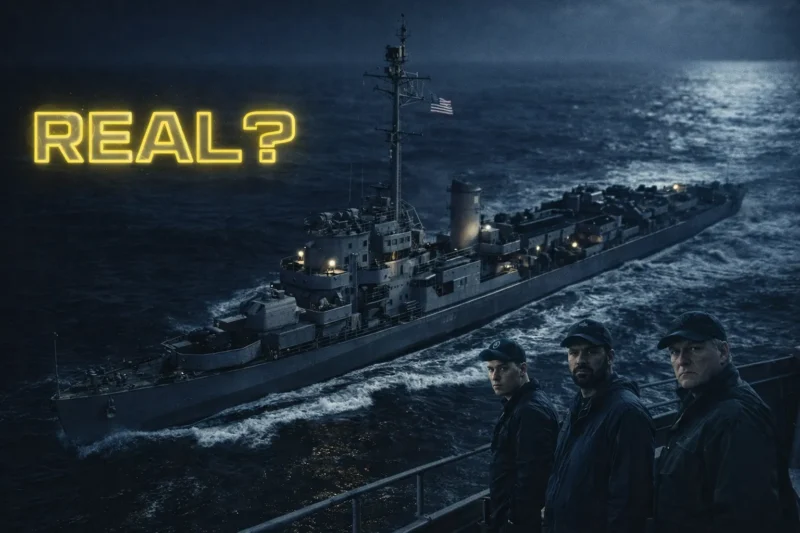
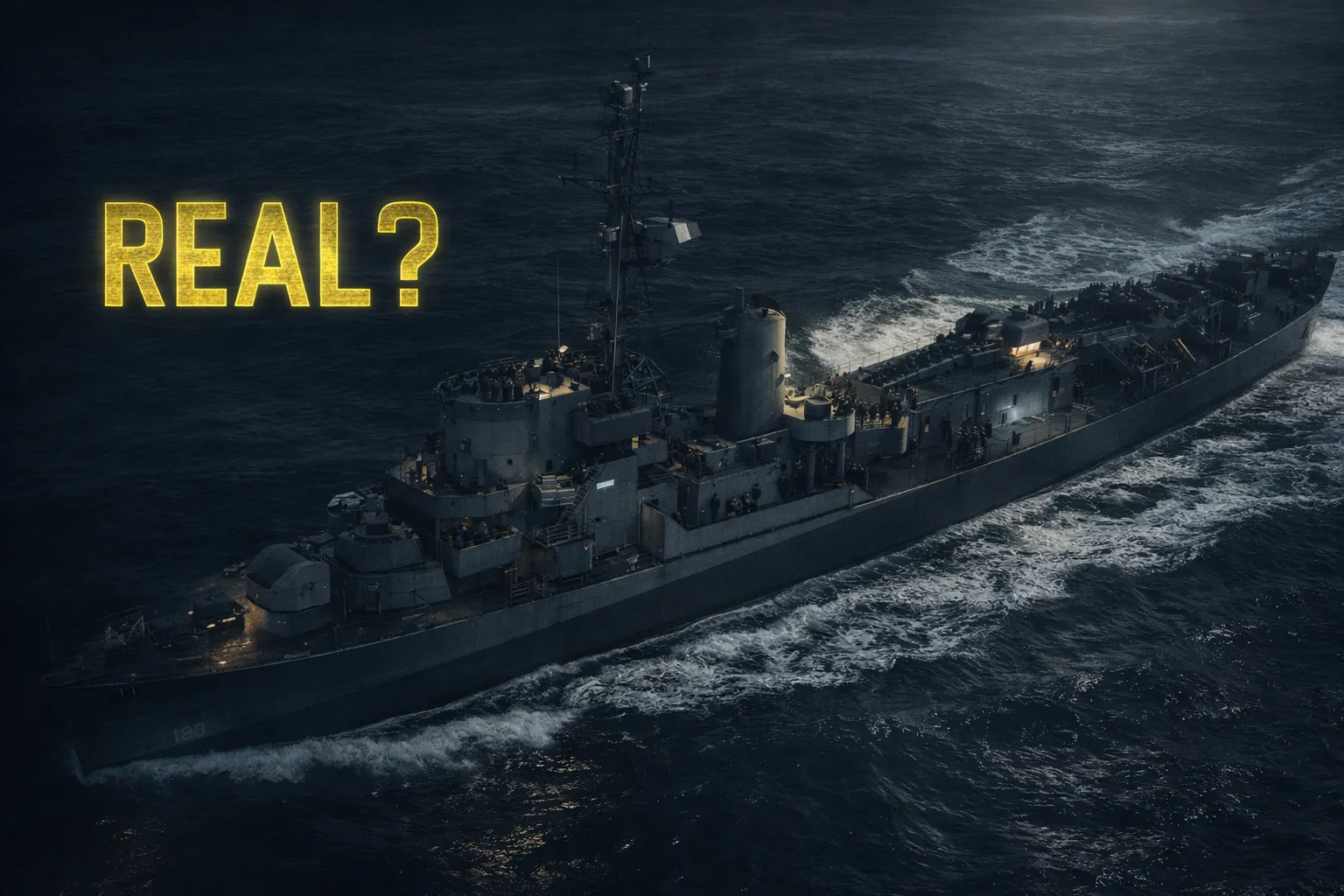
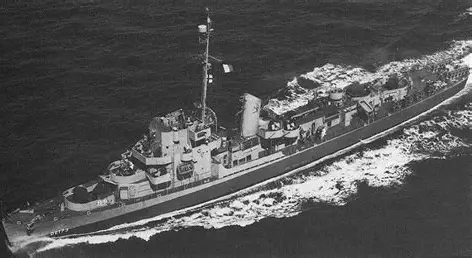
In 1943, according to one of the most persistent military legends of the 20th century, the U.S. Navy made a destroyer escort disappear.
Not metaphorically. Not strategically.
Physically invisible.
The Philadelphia Experiment supposedly used advanced military technology to render the USS Eldridge unseen — and maybe even teleport it. Sailors fused into metal. Time distorted. Reality bent.
It sounds like science fiction.
But here’s the part that changes everything:
The real story is far more interesting than the myth.
And when we peel back the layers, we don’t just find a naval rumor — we uncover how modern technological anxiety can generate legends that feel almost real.
Let’s start where the evidence begins.
⚓ What the Historical Record Actually Shows

1️⃣ Verifiable Factual Base
The USS Eldridge (DE-173) was a Cannon-class destroyer escort commissioned by the U.S. Navy in August 1943.
According to U.S. Navy archives, deck logs, and records maintained by the Naval History and Heritage Command, the ship:
- Was launched on July 25, 1943
- Commissioned on August 27, 1943
- Served in Atlantic convoy escort operations
- Was never documented as participating in secret invisibility testing
There is no official documentation indicating:
- Teleportation experiments
- Optical invisibility tests
- Crew disappearance incidents
- Classified electromagnetic field weapon trials aboard the Eldridge
The U.S. Navy has repeatedly stated that no such experiment occurred.
The Smithsonian Institution and multiple naval historians who have reviewed declassified wartime records also confirm there is no archival evidence supporting the extraordinary claims.
That’s the factual baseline.
But then… where did the story come from?
That’s where it gets intriguing.
📜 The Birth of the Legend

1️⃣ Verifiable Factual Base
The Philadelphia Experiment story began in the 1950s — not during World War II.
The key figure: Carl M. Allen, also known as Carlos Allende.
He sent a series of letters to astronomer and UFO researcher Morris K. Jessup, claiming he witnessed an experiment in October 1943 while aboard another vessel.
Allen alleged:
- The USS Eldridge became invisible
- It teleported from Philadelphia to Norfolk
- Crew members suffered horrific side effects
Jessup initially took the claims seriously. But inconsistencies in Allen’s letters were quickly noticed.
By the 1960s, the story had evolved. By the 1980s, Hollywood amplified it with the film The Philadelphia Experiment (1984).
And that’s when the legend solidified.
No wartime documents.
No engineering blueprints.
No credible eyewitness logs.
Just letters. And retellings.
But why did people believe it?
Let’s zoom out.
⚡ The Scientific Context of the 1940s

1️⃣ Verifiable Factual Base
During World War II, the U.S. military was indeed experimenting with advanced technologies, including:
- Radar development
- Electromagnetic degaussing systems
- Electronic countermeasures
Degaussing is particularly important here.
Ships were equipped with cables carrying electric currents around their hulls to neutralize magnetic signatures, reducing vulnerability to magnetic mines.
To an outside observer, this might have looked like:
- Large electromagnetic equipment
- Strange wiring installations
- High-voltage systems
Now imagine being a civilian in 1943 hearing rumors about invisible ships.
It’s not that invisibility existed.
It’s that electromagnetic technology was mysterious and poorly understood by the public.
And mystery breeds mythology.
🧠 My Personal Reading

When I step back, this feels less like a cover-up and more like a collision.
A collision between:
- Rapid wartime technological innovation
- Limited public understanding of electromagnetism
- Cold War paranoia
- And humanity’s fascination with bending reality
In my reading, the Philadelphia Experiment is what happens when advanced but real science meets imagination under pressure.
The 1940s were the era of the Manhattan Project.
If nuclear fission could split the atom…
What else might be possible?
That psychological atmosphere matters.
But I need to be explicit:
There is no credible evidence of teleportation or invisibility testing.
There is no verified documentation of suppressed naval records.
The scientific consensus remains that the experiment, as described, did not occur.
Still…
Why does this myth refuse to disappear?
🧲 The Invisibility Obsession

Invisibility has always fascinated us.
From ancient myths to modern stealth aircraft.
And here’s where reality becomes even more interesting.
Modern militaries do pursue “invisibility” — but in a very specific way.
1️⃣ Verifiable Factual Base
Today, stealth technology focuses on:
- Radar cross-section reduction
- Infrared signature minimization
- Acoustic stealth
- Electronic signature suppression
The U.S. Air Force’s F-22 and F-35 programs use shaping and materials to reduce radar detectability.
The U.S. Navy uses radar-absorbing coatings and angular hull designs.
But this is not literal optical invisibility.
It’s sensor invisibility.
And that difference matters.
NASA and defense research institutions have also studied metamaterials — engineered materials that can manipulate electromagnetic waves. But these applications are limited and do not allow for large-scale invisibility of ships.
Physics, as we understand it, does not support macroscopic teleportation of naval vessels.
Not secretly. Not publicly.
🌎 What This Means Today
Now let’s connect this to the present.
Because the Philadelphia Experiment isn’t really about 1943.
It’s about how we process technological acceleration.
Today we have:
- AI systems generating realistic media
- Quantum computing research
- Hypersonic weapons
- Cloaking experiments at microscopic scales
When technology advances faster than public comprehension, rumor fills the gap.
It reminds me of how ancient maps sparked speculation about lost civilizations — like the mysterious details surrounding the Piri Reis Map. When knowledge seems ahead of its time, we instinctively ask: What are we missing?
The Philadelphia Experiment is a 20th-century version of that instinct.
And in the digital age, myths spread faster than ever.
Which leads to a bigger question.
Are we more vulnerable to technological myths now than in 1943?
🧠 My Interpretation (Carefully Framed)
In my view, the Philadelphia Experiment works like a cultural mirror.
It reflects:
- Fear of secret military projects
- Awe toward electromagnetic science
- Distrust fueled by Cold War secrecy
- Hollywood’s amplification effect
But it does not reflect suppressed teleportation research.
There is no verified evidence of extraordinary military physics breakthroughs being hidden.
The scientific consensus stands.
Still…
There’s a psychological truth here.
When institutions operate with classified programs (which is normal during wartime), imagination fills the blanks.
The myth survives because it scratches a deep itch:
What if reality is more flexible than we think?
And maybe that’s the real experiment.
🧩 The Detail That Changes Everything
Remember the strong loop from the beginning?
Here it is.
The Philadelphia Experiment was never primarily about invisibility.
It was about information gaps.
Carl Allen’s letters emerged during a time when the public had limited access to military records. The Freedom of Information Act didn’t exist until 1966.
Speculation had room to grow.
Today, declassified naval logs contradict the claims.
Historians have cross-checked ship movements.
Crew members interviewed decades later denied the story.
The gap closed.
But the legend stayed.
And that tells us something profound about human cognition:
A compelling narrative often outlives factual correction.
🔓 The Real Question
Was the Philadelphia Experiment real?
Based on:
- Naval archives
- Scientific constraints
- Historical cross-verification
- Institutional statements
The answer is: there is no evidence that it occurred.
But here’s the question that lingers:
Why do we want it to be real?
Is it because invisibility represents power?
Escape?
Control over reality?
Or simply wonder?
In a world where AI now writes, quantum labs manipulate particles, and satellites silently reshape our economy — as explored in the rise of the modern space economy — technological awe hasn’t faded.
It has intensified.
And myths evolve alongside innovation.
🧭 Conclusion — An Open Horizon
I don’t think the Philadelphia Experiment happened.
But I do think something very real happened.
A moment when emerging science collided with imagination.
A moment when secrecy met storytelling.
And from that collision, a legend was born.
No conspiracy required.
Just humans doing what humans have always done:
Trying to make sense of powerful, half-understood forces.
So maybe the better question isn’t whether the USS Eldridge disappeared.
Maybe it’s this:
What modern technologies today might become tomorrow’s legends?
And are we repeating the same pattern — just faster?
If you’re ready to dig deeper into technological myths and reality,
⚡ Say “DISCLASSIFY” if you want to explore the physics limits behind invisibility research.
🔍 Say “PROCEED” if you want to investigate another military mystery.
Because this one may be settled.
But the pattern behind it?
That’s still unfolding.
❓ FAQ
Was the Philadelphia Experiment ever proven to be real?
No. There is no verified historical or scientific evidence supporting the claim that the USS Eldridge became invisible or teleported.
Did the U.S. Navy conduct secret electromagnetic experiments during WWII?
Yes, the Navy developed degaussing systems and radar technologies. However, there is no evidence these involved invisibility or teleportation.
Why does the story persist today?
Because it blends real wartime technology, limited public understanding, and cultural fascination with bending physical laws — amplified by books and films in the 20th century.
The Philadelphia Experiment may not have bent physics.
But it definitely bent storytelling.
And sometimes… that’s just as powerful.
Reference:
- Carroll, Robert Todd (3 de dezembro de 2007). «Philadelphia experiment». The Skeptic’s Dictionary. Consultado em 5 de fevereiro de 2008
- Dash, Mike (2000) [1997]. Borderlands. Woodstock, New York: Overlook Press. ISBN 9780879517243. OCLC 41932447
- Adams, Cecil (23 de outubro de 1980). «Did the U.S. Navy teleport ships in the Philadelphia Experiment?». The Straight Dope. Consultado em 20 de fevereiro de 2007
- «The “Philadelphia Experiment“». Naval Historical Center of the United States Navy. 28 de novembro de 2000. Consultado em 20 de fevereiro de 2007
- Enigmas e Mistérios da Segunda Guerra Mundial – Jesús Hernandez, Madras-2009,
- «Projeto Filadélfia (1
- «Unveiling the first invisibility shield». Bonnier Corporation. Popular Science (em inglês). 269 (4). 132 páginas. 2006. ISSN 0161-7370. Consultado em 25 de março de 2014
- Haas, Guilherme (4 de outubro de 2013). «5 aplicações de metamateriais iguais às capas de invisibilidade». Tecnomundo. Consultado em 25 de março de 2014
- Kateb, George. Emerson and Self-Reliance. Rowman & Littlefield, 2002. pp. 73. ISBN 0742521451
- Constantino, Mateus (27 de junho de 2007). «Invisibilidade social: outra forma de preconceito». Overmundo. Consultado em 25 de março de 2014. Cópia arquivada em 23 de setembro de 2021
- MEUCCI, Arthur (2026). «A invisibilidade social como desrespeito na teoria do reconhecimento de Axel Honneth». ESTUDOS AVANÇADOS. 116 (40): 1-18
- 984)». IMDb. Consultado em 29 de janeiro de 2016