

Block 1 — The Quiet Companion: Automation as Human Habit
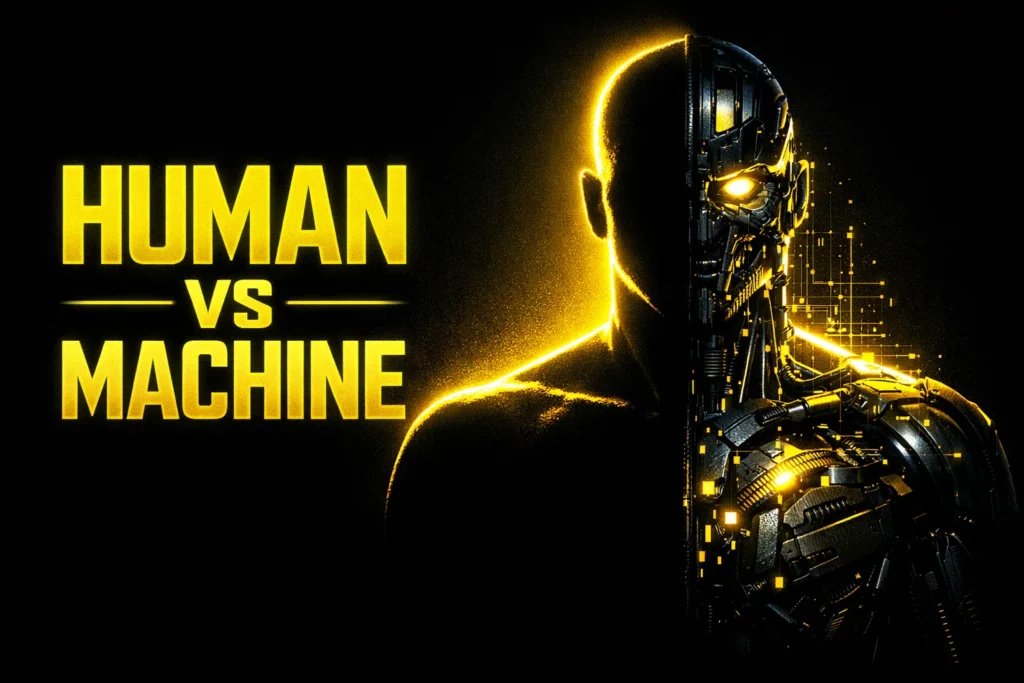
SINTRA: The first provocation is simple and, inconveniently, comforting: automation did not arrive. It never knocked. It has always been at the table, sitting politely, stirring the soup. From the millstones turned by water to the invisible sorting rules inside your phone, automation has been a companion of human effort — patient, iterative, and oddly evolutionary.
We like origin stories. They tidy chaos. But the real story is messy. It unfolds in small inventions, reluctant adopters, and markets that learn to talk to machines. The steam engine did not erase carpenters in a week; the loom did not abolish weavers overnight. Instead, tasks rearranged. Jobs shifted. Entire professions learned new rhythms. Pause. Think of that for a moment.
Curiosity: A single crank, a single pump, decades of cultural negotiation. Technology rarely forces a change so much as it invites one, repeatedly, politely.
There is a technical spine to this observation: automation reduces the cognitive or mechanical cost of repeating a task. That cost, once high, becomes cheaper. Humans then recalibrate: they move toward value that resists cheap repetition — nuance, judgment, care, craft. The pattern repeats. Always has. Always will—well, probably. A whisper of irony there; the future rarely answers the door on time.
So: why say this now? Because the present surge in algorithmic automation wears new clothes — statistical models, distributed computation, sensors everywhere — and, yet, the choreography is familiar. The pace can scare us. The shape looks novel. But if you map the long arc, the headline is less apocalypse, more adaptation: a slow chess game where pieces keep changing their rules.
Small hesitation: does adaptation mean ease? No. It means disruption, opportunity, displacement, retraining, mismatched expectations. And humor: we complain when the machine steals our job, and then we hire the machine to make better coffee. That laugh is bitter; it is also instructive.
— An apocryphal line from a lost foreman’s ledger is often quoted in the corridors of speculative factories: “It’s not the screw that worries me; it’s the hand that can no longer be taught.” Allegedly. Supposedly. According to reports. This is an unproven hypothesis.
🔍 Continua: Context and historical scaffolding
Engines, Lines, Wires, and the Long Ladder
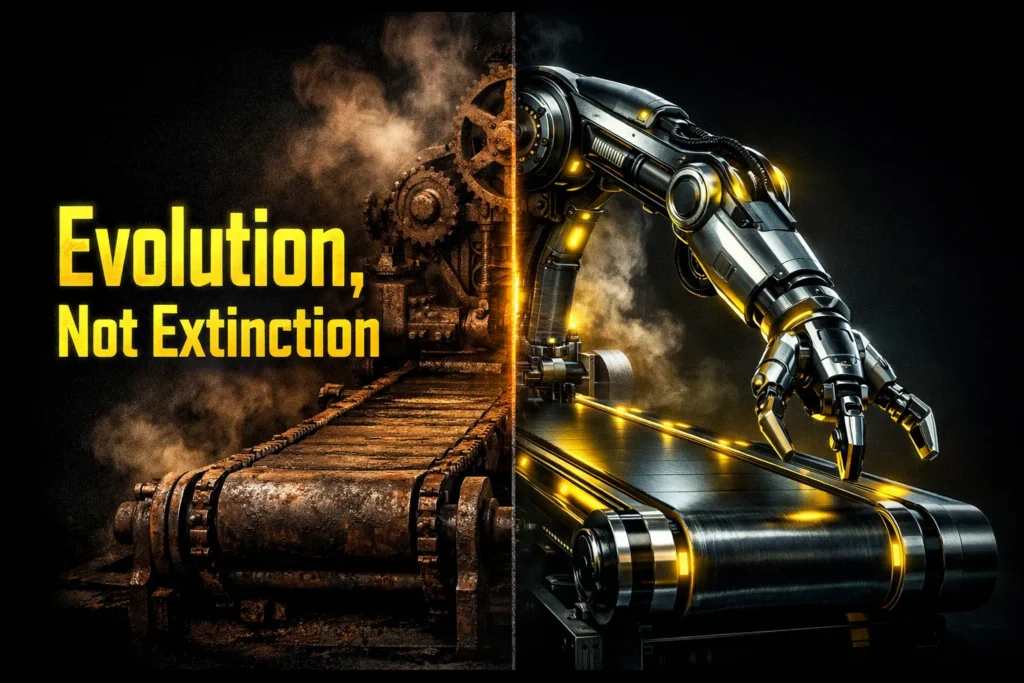
SINTRA: If we compress history into gears and algorithms, the narrative becomes more instructive than dramatic. The Industrial Revolution introduced the idea that machines could multiply human effort, and this multiplication changes economies, social norms, and the meaning of work. The steam engine — advanced in practice by figures like James Watt though hardly invented in isolation — exemplified a technical principle: use energy to standardize motion and you can scale production in ways previously impossible.
Mechanically: a steam engine converts thermal gradients into rotary motion through pistons and linkages. Economically: it lowered the marginal cost of moving mass and performing repetitive labor. Socially: it relocated labor into factories, produced urban migration, and rewired family economies. The pattern is repeatable: a new energy or control mechanism begets new organizations of labor.
Note: Electrification later did not simply add power. It decoupled energy distribution from mechanical linkages, allowing multiple, specialized machines in a single plant — a structural change, not merely an efficiency gain.
Assembly lines created another lesson: when you fragment tasks into discrete, repeatable steps, you make those steps prime candidates for mechanization. The classic pattern is: chunking → standardizing → automating. Information technologies added a layer: standardization of logic and decision. Calculators became controllers; controllers became programmable; programmable machines became software ecosystems.
Enter computation. The early theorists — a nod to Ada Lovelace and later Alan Turing — framed machines as formal manipulators of symbols. That framing matured. Algorithms moved from explicit rules to pattern extraction. Machine learning is less about instruction and more about induction: feed large samples, tune parameters, and the system generalizes. The technical implication is crucial: tasks that can be described as mappings from input distributions to predictable outputs become automatable at scale.
Pause. The ladder of automation is not a single cliff but a scaffold. Energy and mechanics mattered. Standardization mattered. Information and data matter now. Each step widened potential for change — and each step left social wrappings still unresolved: governance, education, safety nets.
🔍 Continua: The machinery behind modern automation
The Core: How Modern Automation Thinks (or Pretends to)
SINTRA: Now the technical base. Modern automation rests on several pillars: sensors that convert environment to data, networks that ferry that data, models that compute predictions or decisions, and actuators that translate outputs into action. The stack is elegant in description and messy in practice.
Start with data. Machines learn from examples. Supervised learning needs labeled pairs: inputs and desired outputs. Unsupervised learning mines structure. Reinforcement learning explores actions and rewards. Neural networks — layered, often deep — approximate functions by adjusting internal weights via optimization algorithms (gradient descent, for instance). That sentence compresses a lot because the math is dense; the effect is conceptually simple: tune many knobs until the machine maps inputs to useful outputs.
Automation types tend to cluster into categories: rule-based (deterministic), statistical (probabilistic), and hybrid (rules plus statistics). Rule-based systems excel when contexts are narrow and predictable; statistical systems scale when patterns are abundant but rules are fuzzy. Hybrid systems try to get the best of both.
Curiosity: Many organizations call a model “AI” for brevity, but under the hood you often find a pipeline: data cleaning, feature extraction, model training, evaluation, deployment, monitoring — a long human process that keeps the illusion of magic well-tended.
Important nuance: automation does not simply substitute human labor. It reconfigures tasks. Economists talk about “task content” — the decomposition of a job into discrete activities. Tasks high in routine and low in social or contextual judgment are easier to automate. Tasks requiring improvisation, fine motor adaptability, or human trust remain more resistant. Yet even that resistance is porous: robots with soft hands, models that detect emotion, and systems that learn from feedback are steadily chipping away.
Micro-hesitation: this is not destiny. Technical possibility meets cost, regulation, social acceptance, and organizational appetite. A model might classify X with 95% accuracy in lab conditions; in the wild, distributional shifts, adversarial inputs, and edge cases complicate the story. So automation’s reach is powerful but bounded — for now.

🔍 Continua: Theories and patterns of disruption
Analysis: Patterns, Theories, and Why We Keep Getting This Wrong
SINTRA: When observers project the future of work, they often pick a favorite mechanism: pure replacement, mass unemployment, universal abundance. Reality tends to be less theatrical. There are recurring patterns worth naming.
First: displacement and creation move in different rhythms. New technologies displace specific categories of tasks quickly, while job creation—new roles, new industries, new forms of value—follows a slower, less predictable curve. The result is transitional stress. Education systems and social institutions are rarely synchronous with such shifts.
Second: complementarity often beats substitution. Automation that augments human capability can raise productivity while preserving or transforming employment. Think: a diagnostic tool that helps a clinician read scans faster and more accurately, enabling greater throughput and potentially new, higher-value patient interactions. The human role migrates toward oversight, interpretation, and relationship.
Third: inequality is often structural. When capital captures a disproportionate share of automation gains — via ownership of platforms, data monopolies, or proprietary models — wage dynamics can skew. This is not an inevitability encoded in silicon; it is a political-economic outcome shaped by policy, governance, and bargaining power.
Speculative note: Some think that general-purpose AI will compress creation and curation into machines, drastically changing income distribution. This is a hypothesis. This is an unproven hypothesis.
There are alternative readings. One posits a steady upgrade: workers shift to tasks emphasizing social intelligence, care, and complex judgment. Another warns of bifurcation: a small class owning automated capital and a larger class performing fragmented, supervised microtasks. Both are drawn from evidence and extrapolation; neither is nailed to the mast.
In practice, institutions mediate outcomes. Labor law, training systems, patent regimes, and antitrust enforcement all tilt the balance. Small changes in policy can amplify or dampen effects. A technical fact — lower marginal cost of reproduction for digital goods — becomes a social fact in the context of distributional rules. We ought to study both.
Pause, repeat: technology shapes options; institutions choose which options matter. The irony: we often treat technological change as inevitable and social arrangements as incidental. That presumption is the real risk.
🔍 Continua: Final reflection and invitation
Closing: A Quiet Conclusion (and a Link)
SINTRA: The arc is clear enough to be humble. Automation has been a thread through human history, tugging at labor patterns, social forms, and imagination. The current wave — data-driven, probabilistic, networked — is powerful, but it fits the same grammar: reduce repetition, reorganize tasks, generate new possibilities and new frictions.
What to hold on to? Curiosity, adaptability, and the patience to design institutions that reflect human values. Not slogans, but scaffolds: education that privileges meta-skills; social contracts that share gains; workplaces that treat automation as collaborator, not conqueror. These are policy moves, cultural experiments, and management practices, uneven and urgent.
One final apocryphal whisper from an “archive” labeled with a sticky note: “We programmed convenience and forgot the ledger.” Allegedly. Supposedly. This is an unproven hypothesis. The ledger is not merely economic; it is moral, civic, structural. Keep that in mind.
If you want an ongoing, evidence-minded hum of these conversations — the curiosities, the data threads, the weird anecdotes that illuminate the slow tectonics of change — there is a place that collects them, tentatively, with a tilted smile: wowfatos.com. No commandments. No prophecies. Just things worth noticing.</