- 🌍 What Science Says About the Formation of the Moon
- The Core Idea:
- 🌑 The “Too Perfect” Moon Problem
- 🧪 The Isotope Puzzle — The Detail That Changes Everything
- 🌎 What the Moon’s Origin Means Today
- 🧠 My Personal Reading (Without Drama)
- ❓ FAQ
- 1. Is there any scientific evidence that the Moon is artificial?
- 2. Why is the Moon unusually large compared to Earth?
- 3. Could life exist on Earth without the Moon?
🌕 Could the Moon Be Less “Natural” Than We Think? — The Moon shouldn’t exist. At least… not like this. So what really happened? Everything
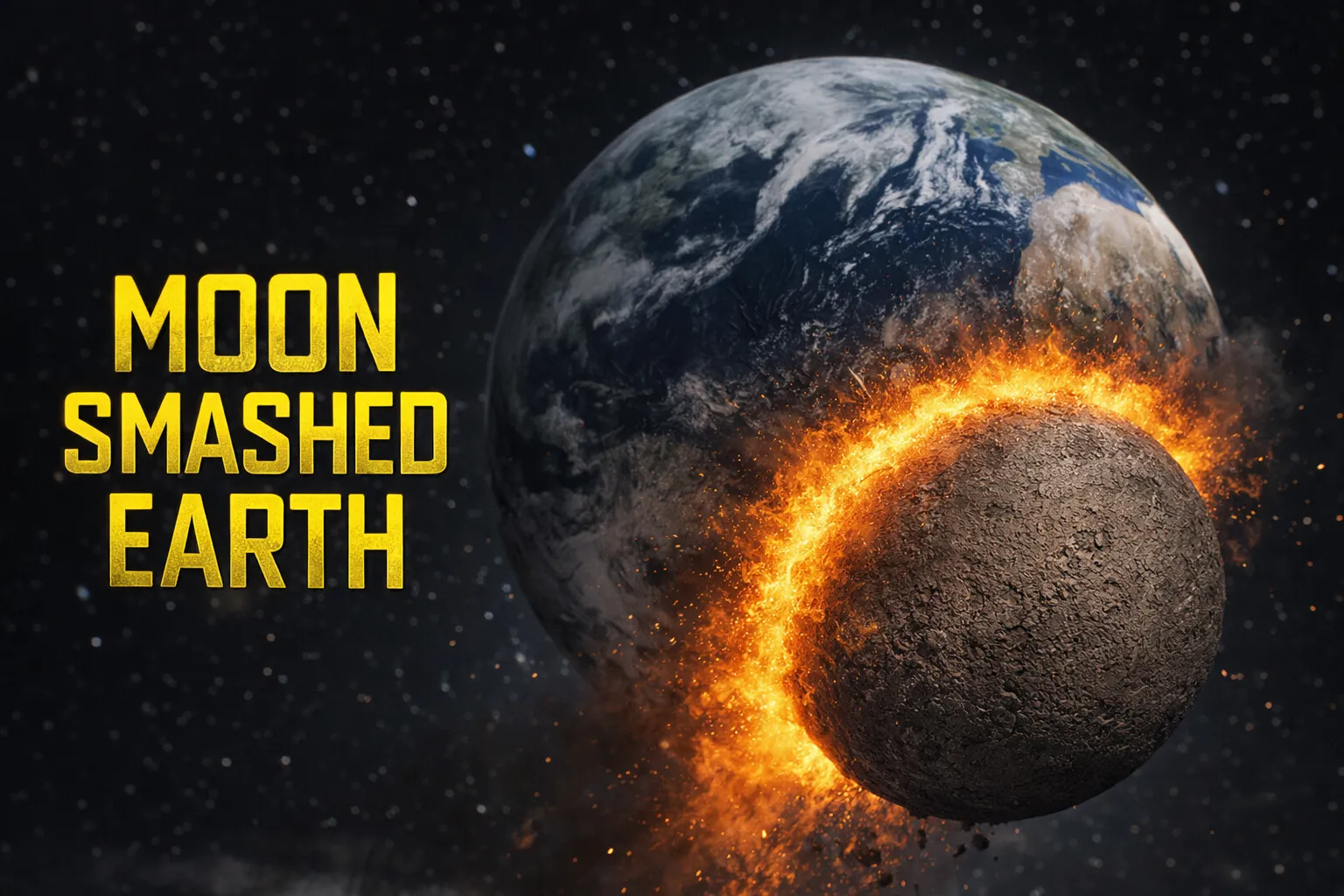
The formation of the Moon is one of the most fascinating chapters in planetary science. According to current research, our satellite was born from a giant impact billions of years ago. A violent collision. A planetary-scale catastrophe.
That’s the official story.
But here’s the detail that changes everything…
Even within the scientific consensus, there are unanswered puzzles — subtle inconsistencies that keep researchers awake at night.
We’ll get to that in a moment.
Because to understand why the Moon sometimes feels “too perfect,” we need to start at the beginning — 4.5 billion years ago.
And trust me… this gets interesting fast.
🌍 What Science Says About the Formation of the Moon
Let’s begin with the solid ground.
According to NASA, the Smithsonian Institution, and multiple peer‑reviewed studies from institutions like MIT, Harvard and Caltech, the leading explanation for the formation of the Moon is the Giant Impact Hypothesis.
The Core Idea:
- Around 4.5 billion years ago
- A Mars-sized protoplanet (nicknamed Theia) collided with early Earth
- Debris from both bodies was ejected into orbit
- That debris gradually coalesced into the Moon
Think of it less like a crash… and more like a cosmic car accident at 100,000 km/h.
Computer simulations from the past two decades support this scenario. Lunar rock samples brought back by the Apollo missions (1969–1972) show striking isotopic similarities to Earth’s mantle.
That similarity is key.
It suggests the Moon formed largely from Earth’s outer layers.
But here’s where curiosity kicks in.
If Theia hit Earth… where is Theia’s distinct chemical signature?
Scientists have been refining models for years to explain this.
Some simulations now propose:
- A high-energy, near head-on collision
- A “synestia” phase — where Earth temporarily became a vaporized, spinning donut of molten rock
- Or even multiple smaller impacts instead of one giant one
The consensus remains the giant impact model.
There is no evidence of artificial construction. No evidence of external manipulation. No evidence of concealment.
But…
The details are still evolving.
And that evolution is where things get intriguing.
🔭 Suggested next investigation: How planetary collisions shaped Mars — and why it lost its magnetic field.
🌑 The “Too Perfect” Moon Problem

Now let me shift gears.
Because when I look at the Moon, I don’t see mystery in a conspiratorial sense.
I see elegance bordering on improbability.
Here are a few curious facts:
- The Moon is about 400 times smaller than the Sun
- It is also about 400 times closer to Earth
- This makes total solar eclipses almost perfectly sized
Pure coincidence? Yes — according to astrophysics.
But still… wow.
Then there’s this:
- The Moon stabilizes Earth’s axial tilt
- Without it, climate fluctuations could be extreme
- Some models suggest complex life may have struggled without that stabilization
That doesn’t mean it was “designed.”
It means planetary chaos sometimes produces remarkable outcomes.
Yet here’s another question that scientists still debate:
Why is the Moon proportionally so large compared to its planet?
Most moons in the solar system are tiny compared to their host planets. Ours is unusually massive.
The Earth‑Moon system behaves almost like a double planet system.
Again — not evidence of anything artificial.
Just unusual.
And unusual things deserve attention.
🌌 This reminds me of how ancient civilizations looked at eclipses with awe — similar to the cosmic symbolism discussed when exploring the Hopi and Mayan prophecies. Different lens. Same sky.
But here’s the deeper layer.
The Moon is slowly drifting away from Earth — about 3.8 centimeters per year.
Which means in the distant past, it was much closer.
And in the distant future… total solar eclipses will no longer exist.
We just happen to live during the epoch where they are geometrically perfect.
Coincidence?
Yes.
But it’s a fleeting one.
And that temporal alignment adds a strange poetic edge to the story.
Now we step into something even more fascinating.
Because the mystery isn’t whether the Moon is artificial.
It’s whether our understanding of its birth is complete.
🧪 The Isotope Puzzle — The Detail That Changes Everything

Here’s the loop I opened earlier.
Lunar samples collected by NASA astronauts show that oxygen isotopes in Moon rocks are nearly identical to Earth’s.
That’s unexpected.
If Theia was a different planetary body formed elsewhere in the solar system, we’d expect detectable differences.
Yet the chemical fingerprints are almost indistinguishable.
So what are the scientific possibilities?
- Theia formed in a very similar orbital region as Earth
- The impact mixed material so thoroughly that differences vanished
- Or the proto‑Earth and Theia were compositionally nearly identical from the start
Recent high-resolution simulations support high‑energy impact models that blend materials extensively.
In my reading, this doesn’t weaken the giant impact hypothesis.
It refines it.
But here’s the curiosity staircase moment:
If planetary formation is that chaotic and dynamic…
How many other Earth‑Moon-like systems exist out there?
And how many are required for life to emerge?
Now we’re not talking about conspiracy.
We’re talking about probability.
Which is far more interesting.
🚀 This connects loosely to discussions about the growing space economy and orbital infrastructure — because understanding our Moon’s origin shapes how we plan future lunar missions.
And here’s the explicit boundary:
There is no scientific evidence that the Moon is artificial.
There is no evidence of hidden information.
The giant impact hypothesis remains the dominant and evidence‑supported explanation.
But science is iterative.
It updates.
And the Moon keeps challenging simulations.
That’s not mystery theater.
That’s good science.
🌎 What the Moon’s Origin Means Today
Why does this matter now?
Because we are returning to the Moon.
NASA’s Artemis program aims to establish a sustainable human presence on the lunar surface this decade.
Private companies are planning lunar mining, resource extraction, and infrastructure.
Understanding the Moon’s origin helps determine:
- Internal structure
- Mineral distribution
- Volatile content (like water ice)
- Long-term stability for bases
The Moon is not just a nightlight anymore.
It’s becoming an economic frontier.
And the deeper we understand its formation, the better we understand:
- Planetary evolution
- Habitability conditions
- Our own origin story
Which brings me to a reflection.
🧠 My Personal Reading (Without Drama)
When I look at the Moon, I don’t see an artificial object.
I see a fossil of violence.
A reminder that Earth survived something catastrophic.
And somehow… from that chaos, stability emerged.
Life emerged.
Consciousness emerged.
In my view, the “less natural than we think” idea isn’t about artificial construction.
It’s about how wild, extreme, and improbable natural processes really are.
The Moon isn’t less natural.
It’s more dramatic than we usually admit.
And maybe that’s what unsettles us.
We prefer gentle origins.
But reality often begins with impact.
And here’s the final loop:
If a planetary collision helped create the stable conditions for life on Earth…
Then catastrophe wasn’t an obstacle to life.
It was part of the recipe.
That shifts perspective, doesn’t it?
🔓 Say “REVEL” if you want to explore the synestia model in detail.
🌌 Say “TRANSCEND” if you’re ready to question how rare Earth‑Moon systems might be.
❓ FAQ
1. Is there any scientific evidence that the Moon is artificial?
No. There is no credible scientific evidence supporting artificial origin claims. The giant impact hypothesis remains the best-supported explanation.
2. Why is the Moon unusually large compared to Earth?
The giant impact likely produced a large debris disk, allowing formation of a relatively massive satellite. This makes Earth‑Moon somewhat unique but not unnatural.
3. Could life exist on Earth without the Moon?
Possibly, but models suggest climate stability might have been more chaotic. The Moon likely contributed to long-term environmental stability.
The Moon rises tonight the same way it did for ancient astronomers, medieval sailors, Apollo astronauts, and now — us.
We think we understand it.
Maybe we mostly do.
But every time science refines the impact model, every time new isotope data appears, every time simulations shift slightly…
It whispers something subtle:
“Formation stories are rarely simple.”
And maybe that’s the real wonder.
Not that the Moon is artificial.
But that nature, when pushed to extremes, can look almost intentional.
What do you see when you look up?
Reference;
- Edward Be
- Hartmann, William K.; Davis, Donald R. (April 1975). “Satellite-sized planetesimals and lunar origin”. Icarus. 24 (4): 504–515. Bibcode:1975Icar…24..504H. doi:10.1016/0019-1035(75)90070-6.
- Cameron, A. G. W.; Ward, W. R. (1976). The Origin of the Moon. Abstracts of the Lunar and Planetary Science Conference. Vol. 7. p. 120. Bibcode:1976LPI…..7..120C.
- Canup, R. M.; Asphaug, E. (December 2001). An impact origin of the Earth-Moon system. Fall Meeting 2001. Vol. 2001. American Geophysical Union. pp. U51A–02. Bibcode:2001AGUFM.U51A..02C.
- Canup, Robin M.; Righter, Kevin, eds. (2000). Origin of the earth and moon. The University of Arizona space science series. Tucson, Ariz: University of Arizona Press. ISBN 978-0-8165-2073-2.
- lbruno, J. Richard Gott III (19 de maio de 2004). «Where Did The Moon Come From?» (em inglês). arXiv.org / Cornell University Library. Consultado em 5 de setembro de 2013
- Marcelo Garcia (22 de outubro de 2012). «Rocha da minha rocha». Instituto Ciência Hoje. Consultado em 10 de setembro de 2013