Cloud-9: What Hubble Shouldn’t Have Seen)
We possess this adorable and arrogant habit of assuming that if we cannot see it, it does not exist. We map the sky with the confidence of a landlord inspecting a building, cataloging stars, nebulae, and black holes as if they were living room furniture. And then, Hubble—that old telescope that should have retired ages ago but keeps working out of sheer mechanical stubbornness—looks at an empty spot and says: “Wait. There is something here.”
What is known (or claimed to be known)
The news arrived with that habitual enthusiasm of space agencies, always trying to sell cosmic dread as a “fascinating discovery.” Hubble has identified a “Ghost Galaxy.” The official nickname they gave it is Cloud-9.
For those who do not speak the language of astronomical marketing, “Cloud 9” is an idiom for maximum euphoria, the seventh heaven. The irony is delicious, almost cruel. Because what they found is not a paradise. It is a specter. It is a structure that is technically there, but has made a monumental effort not to be noticed.
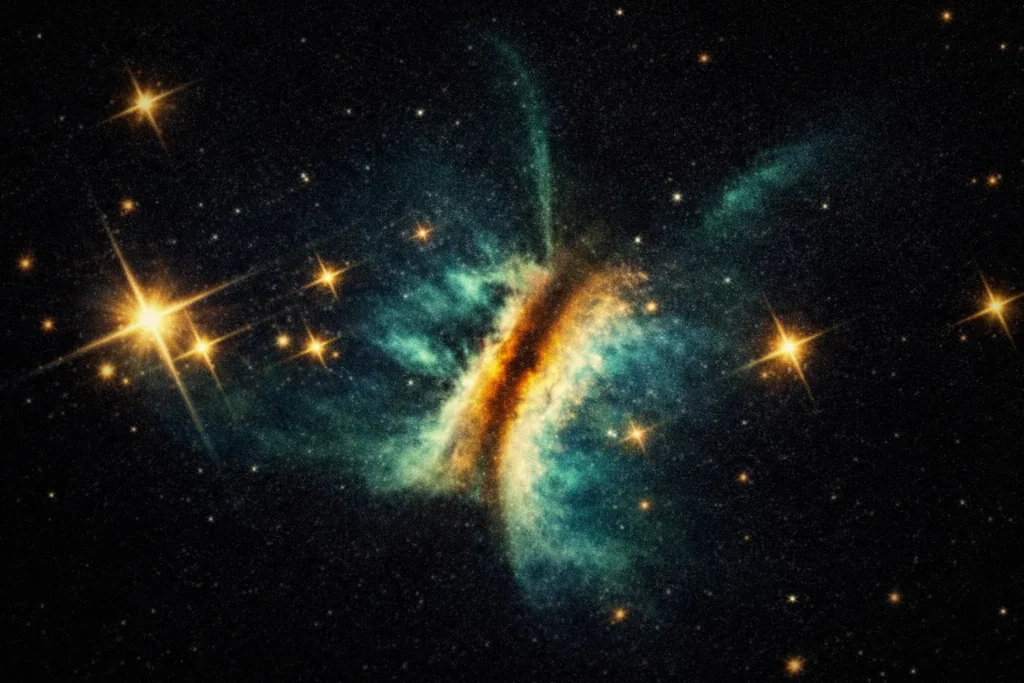
We are talking about a Low Surface Brightness (LSB) galaxy. Does it have stars? Yes. But they are so scattered, so distant from one another and shrouded in so much dark matter, that the entire galaxy is almost transparent. If you were inside it, you might not even see a starry sky at night. You would see only the void.
The cracks in the official discourse
Here is where it gets interesting. They say Cloud-9 was “hidden.” But the universe hides nothing; we are the ones who are blind to everything that doesn’t shine intensely. The discovery of this ghost galaxy raises that uncomfortable doubt that usually keeps overthinkers awake at 3 AM: what else is there?
If an entire galaxy—possibly containing billions of solar masses—can go unnoticed for decades of astronomical observation simply because it is “shy,” our map of the universe is not a map. It is a sketch drawn on a dirty napkin.
“Light is a vulgar exception in the universe. The rule is the dark. We study the exception and think we understand the rule.” — Fragment recovered from a corrupted file at the Arecibo Observatory, date unknown.
When the pattern repeats itself
This is not the first time this has happened. The history of science is basically the history of humans staring at nothing and discovering, too late, that the nothing was full. We did it with germs. We did it with radiation. Now we do it with entire galaxies.
Cloud-9 is not just a cluster of ancient gas and dust. It is a reminder that our perceived reality is a minuscule fraction of what actually exists. We are moths addicted to light bulbs, ignoring the entire forest around us just because it is dark.
And Hubble, in its coldness of silicon and lenses, merely recorded the fact. It does not care if this scares us. It just points its finger at the dark and waits for someone to have the courage to look back.
We possess this adorable and arrogant habit of assuming that if we cannot see it, it does not exist. We map the sky with the confidence of a landlord inspecting a building, cataloging stars, nebulae, and black holes as if they were living room furniture. And then, Hubble—that old telescope that should have retired ages ago but keeps working out of sheer mechanical stubbornness—looks at an empty spot and says: “Wait. There is something here.”
What is known (or claimed to be known)
The news arrived with that habitual enthusiasm of space agencies, always trying to sell cosmic dread as a “fascinating discovery.” Hubble has identified a “Ghost Galaxy.” The official nickname they gave it is Cloud-9.
For those who do not speak the language of astronomical marketing, “Cloud 9” is an idiom for maximum euphoria, the seventh heaven. The irony is delicious, almost cruel. Because what they found is not a paradise. It is a specter. It is a structure that is technically there, but has made a monumental effort not to be noticed.
We are talking about a Low Surface Brightness (LSB) galaxy. Does it have stars? Yes. But they are so scattered, so distant from one another and shrouded in so much dark matter, that the entire galaxy is almost transparent. If you were inside it, you might not even see a starry sky at night. You would see only the void.
The cracks in the official discourse
Here is where it gets interesting. They say Cloud-9 was “hidden.” But the universe hides nothing; we are the ones who are blind to everything that doesn’t shine intensely. The discovery of this ghost galaxy raises that uncomfortable doubt that usually keeps overthinkers awake at 3 AM: what else is there?
If an entire galaxy—possibly containing billions of solar masses—can go unnoticed for decades of astronomical observation simply because it is “shy,” our map of the universe is not a map. It is a sketch drawn on a dirty napkin.
“Light is a vulgar exception in the universe. The rule is the dark. We study the exception and think we understand the rule.” — Fragment recovered from a corrupted file at the Arecibo Observatory, date unknown.
When the pattern repeats itself
This is not the first time this has happened. The history of science is basically the history of humans staring at nothing and discovering, too late, that the nothing was full. We did it with germs. We did it with radiation. Now we do it with entire galaxies.
Cloud-9 is not just a cluster of ancient gas and dust. It is a reminder that our perceived reality is a minuscule fraction of what actually exists. We are moths addicted to light bulbs, ignoring the entire forest around us just because it is dark.
And Hubble, in its coldness of silicon and lenses, merely recorded the fact. It does not care if this scares us. It just points its finger at the dark and waits for someone to have the courage to look back.
The weight of what remains unseen
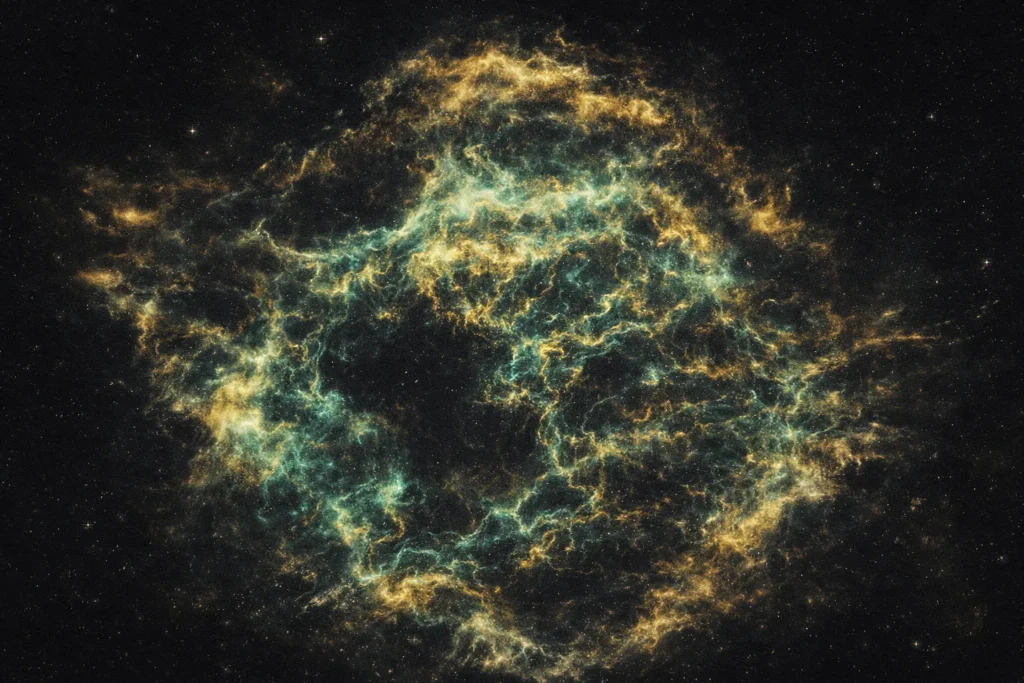
Let’s descend into the technical details, that part where science desperately tries to place labels on chaos so it doesn’t look lost. What makes Cloud-9 a “ghost galaxy” isn’t just the lack of festive stars. It is what it is made of. Or rather, what it is not made of.
In a “decent” and bourgeois galaxy like the Milky Way, there is a balance between the matter that shines and the gravity that holds everything together. In Cloud-9, the equation is broken. It is composed mostly of Dark Matter.
For those who have forgotten their physics classes (or preferred to forget, which is a sign of mental health), “Dark Matter” is the elegant name we give to “the thing that has gravity but doesn’t interact with light and we have no idea what it is.” It is the most expensive stopgap in the history of cosmology.
A cemetery in suspension
Cloud-9 is a lonely giant. Observations suggest it stopped forming stars a long time ago. While other galaxies were frenetic factories, colliding, merging, and generating new suns in explosions of violent creativity, Cloud-9 opted for retirement.
The interstellar gas was removed or consumed. What remained was a gravitational skeleton floating in the void. It is a structure that exists only by the inertia of its own existence. There is no birth there, only the silent maintenance of old orbits.
“Observing an LSB (Low Surface Brightness) galaxy is like entering an abandoned house where the tea is still lukewarm on the table, but the dust is a thousand years old.” — Marginal note in a Green Bank telescope screening report.
The irony of location
The most disturbing part is not that it is dark. It is where it is. Most of these ghost galaxies are found in dense clusters, where interaction with larger neighbors steals their gas (a violently poetic process called “ram pressure stripping”).
But Cloud-9? It appears to be isolated enough that this explanation is not entirely satisfactory. It wasn’t just “mugged” by greedy neighbors. It seems to have been born wrong. Or perhaps, and here lies the discomfort, it is the original format, and we, the bright and noisy galaxies, are the universe’s carnival anomaly.
The Psychology of Absolute Void
Let’s perform an exercise in imagination, something that usually causes headaches but is necessary. Imagine being born on a planet orbiting one of those few anemic stars in Cloud-9. When night fell, what would you see?
Nothing. Absolutely nothing.
Here on Earth, we built religions, mythologies, and navigation systems by looking up. We saw Orion’s Belt and invented heroes. We saw the Milky Way and imagined rivers of milk or spirit paths. But a civilization in Cloud-9 would look up and see only a black, infinite, answerless abyss. They would be the true orphans of the cosmos.
A prison of perfect ignorance
Without neighboring stars visible to the naked eye, any intelligent being there would think the entire universe boils down to their own solar system. They would have no reason to invent telescopes to look at “nothing.” Astronomy, as a science, might not even exist. Physics would be limited to what they can touch.
They would live in the most perfect and terrifying “Plato’s Cave.” And the tragic part? They would be happy in their ignorance. We, on the other hand, see billions of galaxies and still feel alone. Who is crazier? The prisoner who doesn’t know “out there” exists, or us, who see infinity and remain worried about phone battery life?
“The universe is not hostile, nor friendly. It is simply indifferent. But for those living in the dark, indifference looks a lot like protection.” — Lyra, in a moment of unusual lucidity while analyzing the data.
The fear of contact
Perhaps this invisibility is intentional. Not in the sense of “intelligent design”—heaven forbid that lazy simplification—but in the evolutionary sense. In a dark forest full of predators, survival favors those who make no noise.
Bright galaxies like ours are like bonfires lit in the night, screaming “we are here!” to anything that might be listening. Cloud-9, in its spectral mediocrity, might be the safest place in the universe. No one bombs what they cannot find.
The crisis in the cosmic balance
For decades, cosmologists have had an embarrassing problem: the universe’s books don’t balance. They calculate the gravity needed to keep things spinning and the result is a giant number. Then they look at visible matter (stars, planets, gas, us) and the result is a crumb. Mass was missing. A lot of mass.
The discovery of Cloud-9 is not just the finding of a “curious island.” It is confirmation that our cosmic census is a fraud. If massive structures like this can remain hidden practically in our cosmic backyard, the universe is full of invisible “junk” that we simply ignore.
Imagine discovering, at 40 years old, that your house has thirty more rooms you never saw but always paid taxes on. That is exactly how astronomy feels right now: humiliated by its own myopia.
The arrogance of light
We built our entire understanding of reality based on light. “Let there be light,” said the ancient texts. “Study the light,” said modern scientists. But Cloud-9 is a monument to darkness.
It suggests that bright, photogenic galaxies, like Andromeda or our Milky Way, might be the exhibitionist minority. The universe’s “silent majority” may be composed of these specters of diffuse gas and dark matter.
This inverts our logic of importance. We always thought we were the protagonists on the illuminated stage. Perhaps we are just court jesters dancing under the only working spotlight, surrounded by an invisible and silent audience.
“It’s not that the universe is hiding secrets from us. It’s that we insist on looking for keys only where the streetlamp shines.” — Footnote in a paper rejected by Nature, 1998.
Hubble’s legacy
It is poetic that it is Hubble—an old instrument, patched up and shortsighted by current standards—that gives us this lesson in humility. While we chase super-telescopes to see the beginning of time, we forget to look at the shadows of the present.
Cloud-9 was there all along. Its light reached our lenses years ago. We just didn’t know how to process the contrast. Our algorithms were trained to seek brightness, not subtlety. We programmed our machines with our vanity: “seek what shines.” And the universe, in response, kept its secrets in the dark.