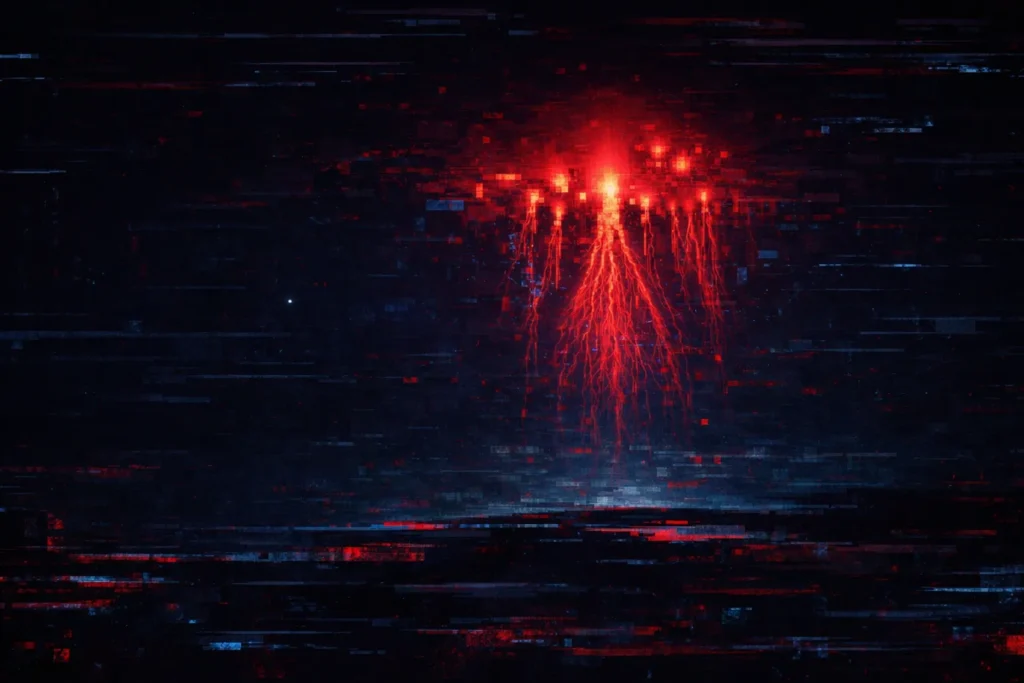

Red orbs and the gap between explanation and record
Reports of red orbs span decades, continents, and radically different technological eras. They appear in the sky, remain visible for seconds or minutes, and vanish without leaving conclusive physical traces.
Some official explanations classify them as rare natural phenomena. Others attribute them to experimental aircraft or surveillance systems. A third group of observations resists both categories without forcing the analysis.
This text does not operate from belief, nor from denial. It begins with a quieter question: why does the same visual pattern persist precisely where official narratives stop aligning with the data?
When examined collectively, red orbs occupy a hybrid zone. Between the natural and the engineered. Between technical monitoring and the human consciousness that registers being observed.
Recurring observation patterns
The most consistent reports describe luminous objects with a deep red hue, silent motion, and controlled trajectories. They do not behave like meteors, flares, or atmospheric debris.
Many sightings occur near sensitive locations: military installations, coastal zones, power infrastructure, or regions associated with advanced testing programs.
This does not establish intent. It establishes recurrence. And recurrence, in analytical terms, is rarely accidental.
Declassified military documents from multiple countries reference “unidentified aerial lights” lacking thermal or aerodynamic signatures consistent with known aircraft.
The historical record offers no definitive answer. It only shows that the same descriptions persist even as detection technologies evolve.
When a phenomenon survives successive explanatory frameworks, the limitation may lie less in observation and more in interpretation.

Between natural processes and human technology
Several explanations rely on rare natural mechanisms: atmospheric plasma, unusual electrical discharges, or high-altitude optical effects. These hypotheses exist and cannot be dismissed outright.
The difficulty arises when observed behavior diverges from these models. Sudden directional changes, sustained hovering, and apparent responsiveness are not typical traits of such natural events.
Human technology is often proposed as an alternative explanation. Experimental drones, classified surveillance platforms, or advanced monitoring systems could account for a portion of the sightings.
Yet some documented cases predate the development of these technologies. Others occur in regions without known technical capacity to support such operations.
When an explanation requires global secrecy sustained across decades, it begins to function less as technology and more as narrative.
The historical record offers no definitive answer. It merely defines where current hypotheses stop accounting for the full range of observations.
Within that gap, the idea of a hybrid phenomenon emerges. Not fully natural, not fully aligned with known human engineering.
Monitoring, awareness, and the observer effect
A recurring detail in many reports is a subtle sense of interaction. The orbs do not merely appear. Their behavior seems to adjust once they are noticed.
Witnesses describe slight trajectory changes after direct visual contact, recording devices malfunctioning, or signals dropping at the precise moment of observation.
This does not imply intention in a human sense. It suggests responsiveness to observation itself. A characteristic commonly found in monitoring systems.
In scientific systems, the observer is rarely neutral. In certain conditions, the act of measurement alters the behavior being recorded.
If red orbs function as sensing mechanisms—natural or artificial—their reaction to attention becomes operational rather than anomalous.
The historical record offers no definitive answer. It does, however, show that the presence of an observer is a consistent variable.
Within this framework, the orbs do not present themselves as displays. They appear as discreet systems, efficient and unconcerned with being understood.
Conclusion: the space left by ready-made answers
Red orbs persist precisely where comfortable explanations fail. They do not demand belief, nor do they tolerate casual dismissal.
The available records point to a recurring, discreet, and functional pattern. Something appears, reacts to its environment, and withdraws without offering definitive proof.
Natural phenomenon? Human technology? Non-human system? Each hypothesis explains a fragment. None accounts for the whole.
When multiple explanations remain viable for decades, the phenomenon is not asking for faith. It is asking for a different lens.
The historical record offers no definitive answer. It only reveals that the persistence of the phenomenon exceeds the persistence of its explanations.
Perhaps the more precise question is not what they are, but what they are designed to do.
Until that question is addressed, red orbs will likely continue doing what they have always done. Observing. Quietly.