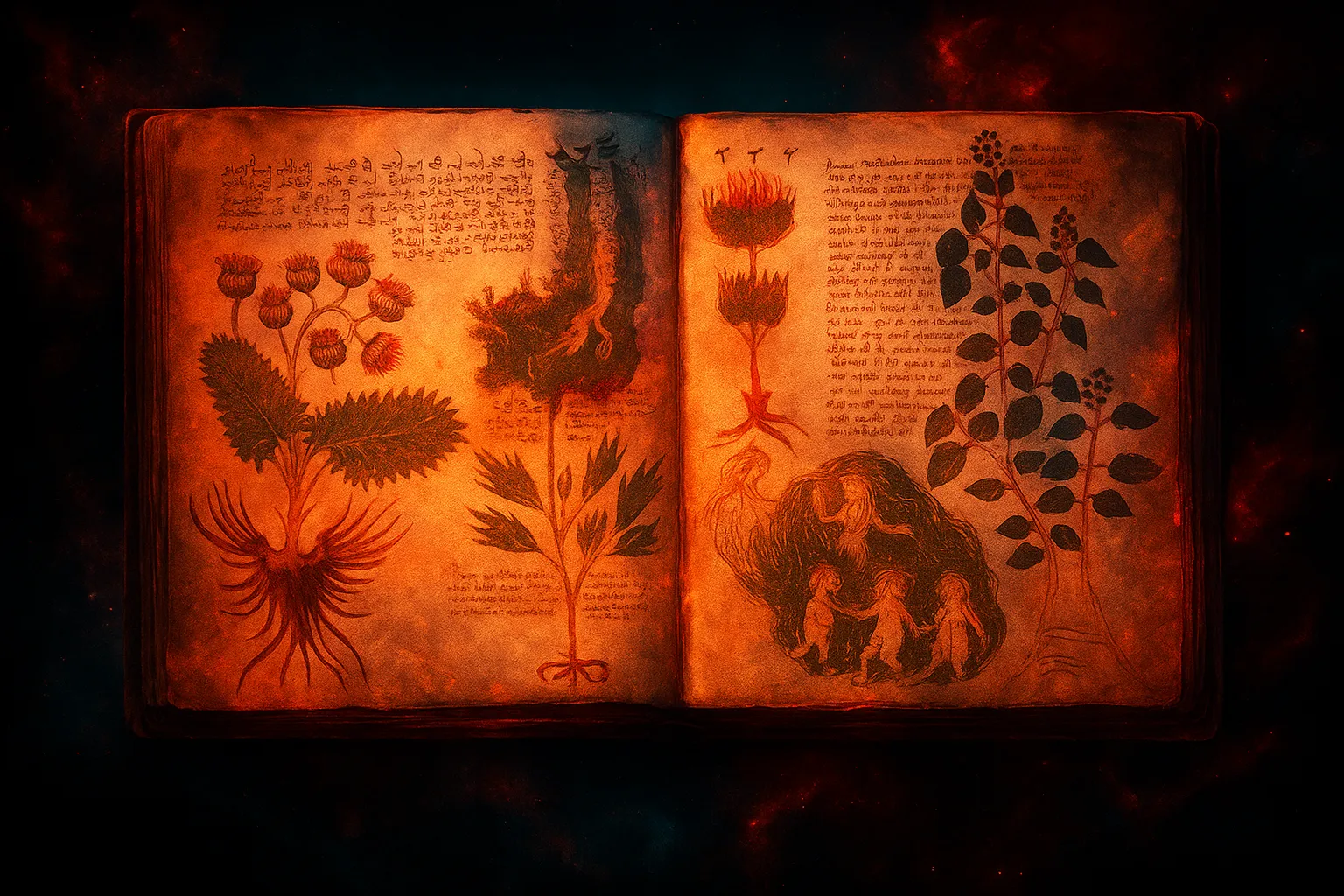
The baths are not baths but embryonic canals, diagrams of alien anatomy, or even terraforming schematics. The rosette foldout? A star map of a sky not seen from Earth, with pipelines charting wormholes and the “plants” serving as keys to interstellar ecosystems.
Hunter
The Voynich Manuscript sits at the crossroads of wonder and frustration: a lavishly illustrated 15th‑century codex filled with plants no botanist can name, astronomical wheels that don’t quite map the heavens, and fluid lines of script that resemble language but yield no agreed meaning. For more than a century, scholars, cryptanalysts, and dreamers have chased its secrets—finding patterns, proposing codes, and testing machines—only to be returned, again and again, to that mesmerizing page-turning silence.
Unveiling the Voynich: a codex wrapped in myth
The Voynich Manuscript—also cataloged as Beinecke MS 408—is a compact vellum codex of roughly 240 folios, many with elaborate foldouts. Its pages carry herbal drawings, zodiac wheels, and interlacing baths of greenish water, all annotated in an unknown script. Radiocarbon dating of the parchment places it in the early 1400s, though its exact birthplace remains debated. Its modern fame began when Polish book dealer Wilfrid Voynich acquired it in 1912 and launched it, with a showman’s flair, into public curiosity.
Built like a puzzle box, the book’s materiality tempts the fingers: quires shuffled over time, cutouts and composite rootballs, text margins that invite but rarely offer marginalia. Multispectral imaging has revealed standard iron-gall inks and period pigments rather than anachronistic trickery. A vanished ownership mark linked to Jacobus Horcicky de Tepenec once faintly graced a page, suggesting imperial Prague connections and fueling a provenance that hovers between solid evidence and tantalizing rumor.
Its aura only grows in translation and retelling. In Portuguese, it’s often dubbed o Manuscrito Voynich—o enigma de uma língua ancestral—an apt phrase for a book that looks like language, feels like knowledge, and yet refuses to speak plainly. As a cultural object, it’s become a mirror for each era’s obsessions: alchemy for the 17th century, cryptography for the 20th, and artificial intelligence for the 21st.
🧭: A genuine 15th‑century scientific compendium—likely Central European—structured like a herbal and astrological health manual, compiled by practitioners working within the medical cosmology of their time and perhaps taking pains to limit access through an idiosyncratic script or cipher.
🛸: A Renaissance-era prank that ballooned into legend; or a relic from an off-world botanist mapping Earth’s flora; or even an artifact from a parallel timeline whose script slipped into our reality through a bibliographic crack.
From mysterious origins to a Renaissance spotlight
The manuscript’s pre-1912 life is sketched through letters: in the 1600s, Prague alchemist Georg Baresch puzzled over it; later, Johannes Marcus Marci sent it to Jesuit polymath Athanasius Kircher, pleading for a solution. These documents, preserved with the codex, anchor it in the scholarly circuits of the late Renaissance, where medicine, astrology, and natural philosophy intertwined.
Layered over that paper trail is the persistent rumor that Holy Roman Emperor Rudolf II purchased the book at great cost, perhaps believing it to be the work of the medieval natural philosopher Roger Bacon. While the Bacon attribution is now considered unlikely, imperial Prague’s fascination with esoterica provides fertile ground for the manuscript’s early celebrity—a fabled spotlight in a court that prized wonders.
🧭: The Voynich likely originated in Northern Italy or Central Europe around 1404–1438, moving through learned circles to Prague by the 1600s. Its links to Kircher’s vast network suggest it was seen as a serious, perhaps encrypted, compendium of practical knowledge rather than a hoax.
🧪: A lost notebook of Leonardo; a message hidden by Templars; or a time capsule planted in a Jesuit library to bait future minds. In the wilder tellings, it was sold to Rudolf II not for its content but as a talisman rumoured to attract genius—or guard it.
Plants, stars, and baths: decoding the odd imagery
The herbal section introduces plants that look both familiar and wrong: leaves echo known species, but roots twist into fantastical amalgams as if the illustrator stitched together botany from memory and metaphor. Some argue these are mnemonic composites, or regional variants rendered in a unique visual shorthand; others note that medieval herbals often prized function over exact likeness.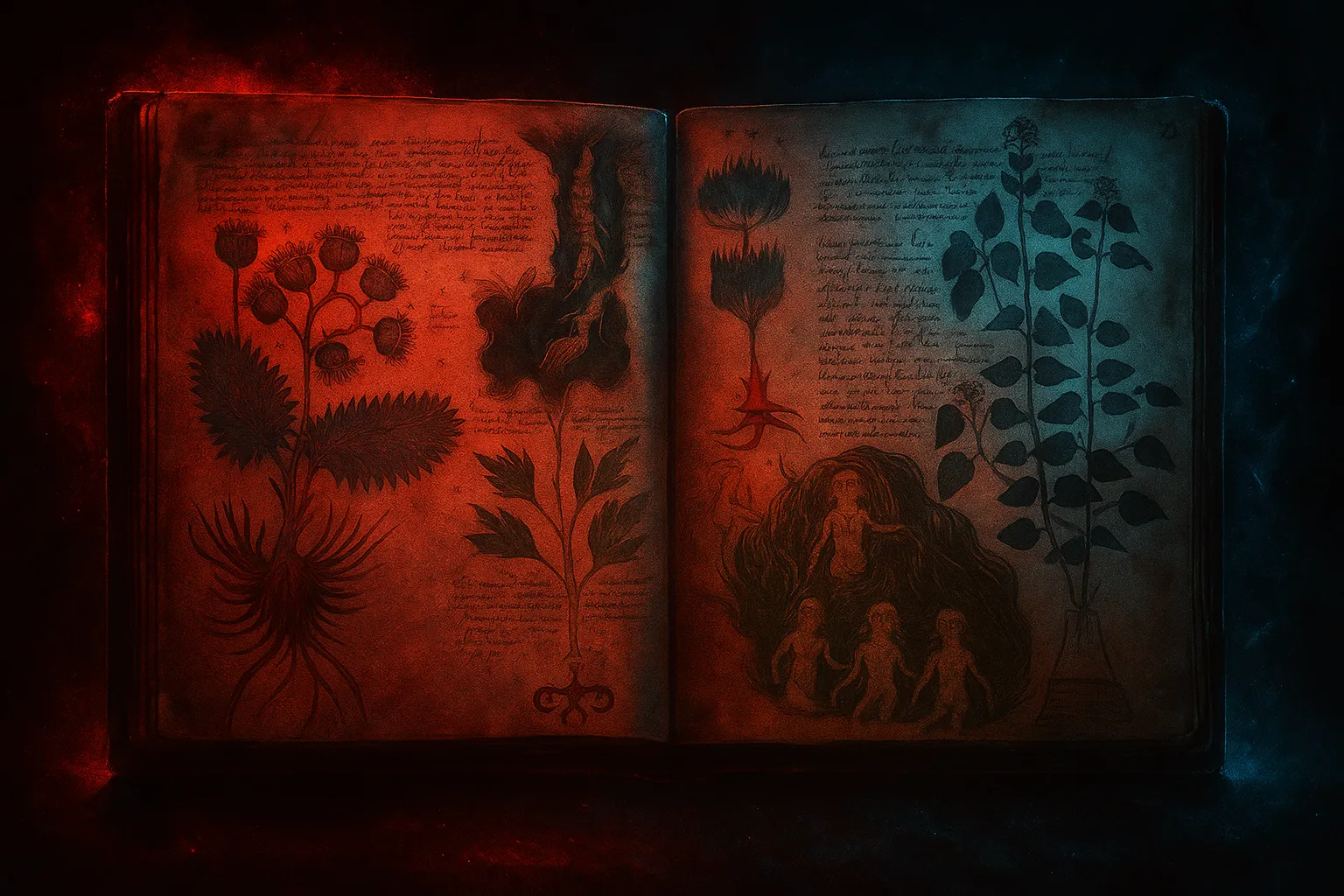
Turn the folios and the sky arrives: zodiac medallions, starburst diagrams, and curious “rosette” foldouts that resemble maps of cosmological space. Threads of astrology run through medieval medicine, so these wheels may have guided treatment schedules, emphasized auspicious timings, or narrativized the body’s relationship to the heavens.
The imagery encodes a medical-astrological handbook, including balneotherapy. The “bathing” nymphs, connected by pipes and vats, map thermal waters and bodily humors; the stars prescribe when to bathe or dose; the plants supply remedies. It’s not incoherence—it’s a holistic system expressed in a period visual grammar.
🧿: The baths are not baths but embryonic canals, diagrams of alien anatomy, or even terraforming schematics. The rosette foldout? A star map of a sky not seen from Earth, with pipelines charting wormholes and the “plants” serving as keys to interstellar ecosystems.
An unknown script or cipher? Linguists weigh in
Voynichese—the nickname for its script—uses about two dozen core glyphs with a few ornate “gallows” characters, arranged into tidy lines and word-like groups. Word lengths cluster around a narrow average; certain glyphs cling to line-starts; and punctuation appears absent. The script is consistent enough to feel learned, yet flexible enough to defy simple substitution.
Statistical analyses reveal properties reminiscent of natural language: Zipf-like distributions, low to moderate entropy, and morphological regularities. Yet there are quirks: frequent near-duplicates and iterative forms, line-position effects, and what some call “context-sensitive spelling.” Currier’s analysis split the text into “A” and “B” varieties, perhaps reflecting different scribes, topics, or stages of composition.
🧭: A real language under a “verbose” cipher or specialized orthography—possibly with nulls, digraphs, and positional rules—crafted to obscure without the heavy mathematics of later cryptography. Multiple hands and dialectal registers (Currier A/B) track a workshop or an evolving project, not fakery.
🌀: A sophisticated hoax generated by a 15th‑century proto-algorithm—tables and grilles producing statistical plausibility without meaning. Or glossolalia set to a scribe’s metronome: a trance-born script that mimics language the way birdsong mimics music.
Modern sleuths, AI, and the enduring allure of code
In the 20th century, elite codebreakers—including members of the Friedman team—attacked the text with frequency counts and classical methods, then left with a rare admission: if it is a cipher, it’s unlike the ones they knew. Later, computational linguists teased patterns but no consensus lexicon; every proposed key opened a few words and locked the rest tighter.
The AI era brought OCR pipelines, topic models, and neural language comparisons. Now and then, a splashy claim matches Voynichese to Hebrew, Nahuatl, or Turkish, only to wither under replication and methodology critiques. The data are small, the script idiosyncratic, and the training biases large—conditions ripe for pareidolia in silicon.
🧭: A solution, if it comes, will be interdisciplinary: codicology to re-sequence quires, multispectral imaging to recover lost marks, stylometry to map scribal hands, and computational models constrained by medieval philology. Progress will be incremental, cumulative, and boring—until the day it isn’t.
🔮: The manuscript is a purposeful labyrinth, calibrated to defeat both human patience and machine patterning. It yields just enough signal to keep us circling, a bibliographic ouroboros feeding on our desire to solve—an artifact that encodes not language, but our compulsion to read.
The Voynich Manuscript endures because it straddles two irresistible edges: the hope that a human mind, somewhere, put real meaning in those pages, and the fear that meaning might be precisely what the book withholds. Until someone cracks it—or proves it uncrackable—it will remain our most beautiful unanswered question. Dare to turn another page.