
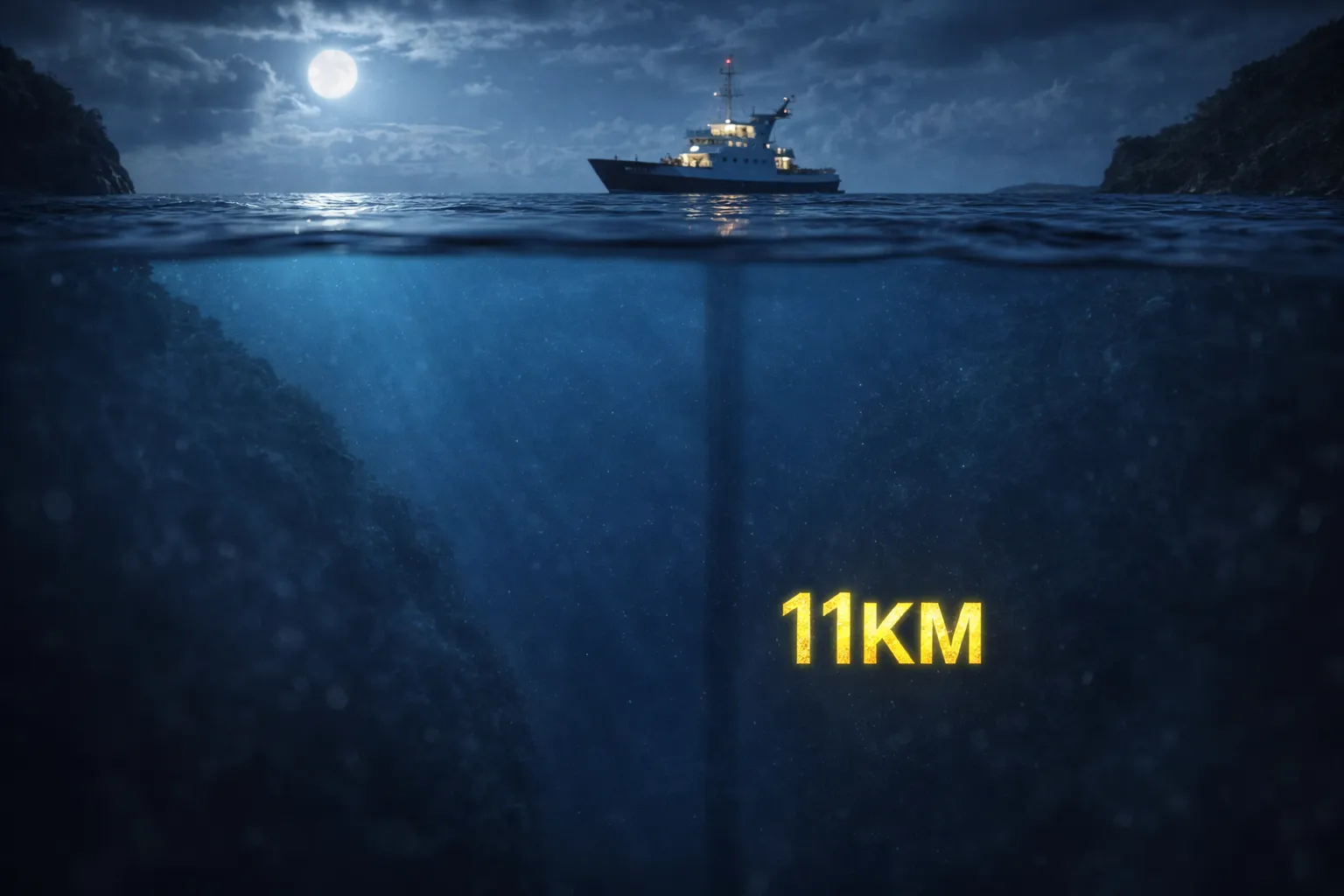


Decoding the Challenger Deep Enigma — Life at 36,000 Feet and the Science We Still Don’t Understand
“Diving into the Challenger Deep is like trying to read a book in a pitch-black room while someone pours tons of concrete over your head. It’s the physical limit of our existence.”
- 📍 Location: Mariana Trench, Pacific Ocean.
- 🧪 Focus: Extreme biology and geological anomalies.
- ⚠️ Note: Investigation based on NOAA data and manned expeditions.
Imagine a place where sunlight has never reached, where the pressure would crush a main battle tank like a soda can, and where temperatures hover just above freezing. This is the Challenger Deep, the lowest point on our planet. For decades, science claimed that life here was a statistical impossibility.
But recent expeditions have revealed something unsettling. We didn’t just find life; we found organisms that seem to operate under a chemical logic we are still trying to decipher. But there is a detail that changes everything about how life began on Earth… something scientists noticed in the DNA of these creatures that shouldn’t be there.
We’ll get to that in a moment.
🧬 1. The Scientific Consensus: The Abyss by the Numbers
According to the Smithsonian Institution and the Woods Hole Oceanographic Institution, the Challenger Deep (sitting at roughly 10,935 meters or 35,876 feet) is the result of a violent geological process called subduction. The Pacific plate is being “swallowed” by the Mariana plate, creating a gash that tears into the Earth’s crust.
In this environment, life needs superpowers. What science has proven:
- Piezophiles: Bacteria that don’t just endure the pressure; they need it so their membranes don’t disintegrate.
- Zero Sunlight: Energy production doesn’t come from the sun, but from chemical compounds spewing from fissures in the seafloor.
- The Snailfish: The deepest vertebrate ever recorded, with bones that feel like flexible cartilage to avoid snapping.
During James Cameron’s 2012 dive, cameras captured microbial mats surviving in total darkness. The structure of these beings suggests a molecular resilience that defies classical biology textbooks.
In my reading, the Challenger Deep isn’t just a “hole in the sea.” It makes me think that perhaps life didn’t start in tide pools under the sun, but in the exact opposite: the chemical heat of the deep Earth. What this suggests to me is that we are neighbors to an ecosystem we’ve barely begun to grasp.
“There is no evidence of a cover-up regarding colossal sea monsters; the real mystery is how the biochemistry of such tiny beings can withstand 8 tons of pressure per square inch.”
🌊 2. Curiosity: The Secret of TMAO
How does a cell not implode down there? The answer lies in a molecule called TMAO (trimethylamine N-oxide). It acts as a chemical “spacer,” preventing the crushing pressure from deforming vital proteins.
Science answered the “how they live there.” But that opens a new and much larger question: if life is this resilient, why hasn’t it spread uniformly across the entire ocean floor?
The answer might lie in something we recently detected: the “Voices of the Abyss.”
Hydrophones placed in the trench captured noises that took scientists months to identify. They weren’t the screams of monsters, but the constant sound of the Earth moving—and something else. We’ll touch on that sound in a bit.
🌍 3. What It Means Today: The Next Economic Frontier?
The Challenger Deep is shifting from a mere laboratory to a point of intense technological interest. The enzymes discovered there are the key to industrial processes requiring extreme pressure and heat.
Evergreen Insight: Currently, marine biotechnology is looking at these creatures to develop new antibiotics. Their resistance to extreme environments could be our salvation against superbugs here on the surface.
💣 This connects EVERYTHING: Deep-sea exploration follows the same pattern as the Space Economy. Those who master the technology to operate in the abyss will master the resources of the future.
🏁 4. Investigator’s Reflection
Ultimately, the Challenger Deep teaches us humility. We are a species that looks at the stars but is only just starting to wet our feet in our own backyard. We’ve debunked medieval sea monster myths, but the reality of life flourishing in the “impossible” is far more gripping.
If life can thrive there, under crushing pressure and in total darkness, what does that tell us about the potential for life on moons like Europa or Enceladus? Are we alone in the universe, or have we simply not looked deep enough in our own backyard?
The final question remains: if human plastic reached those depths before we did, what else are we altering without even knowing it?
❓ FAQ: Deep Dive Details
1. Can a regular submarine reach the bottom?
No. Standard military submarines would implode long before reaching 3,000 feet. Specialized ultra-strong titanium or steel spheres are required.
2. What is the strangest creature found there?
Likely the xenophyophores—giant single-celled organisms that look like sponges and can measure up to 4 inches, which is bizarre for a single cell.
3. Are there tsunami risks originating from this region?
Yes. As an active subduction zone, tectonic shifts in the Challenger Deep are constantly monitored to predict large-scale water displacements.
This reminds me of the Tulli Papyrus case, where the unknown came from the sky, but the pattern of human bewilderment was the same as what we feel looking into the deep sea.
⚡ Next Level:
🔓 REVEAL — New perspectives on the origin of life
🧠 ANALYZE — What the pressure sensors actually detected
👁️ PROCEED — To the next natural enigma
Choose how Hunter should proceed with the investigation.