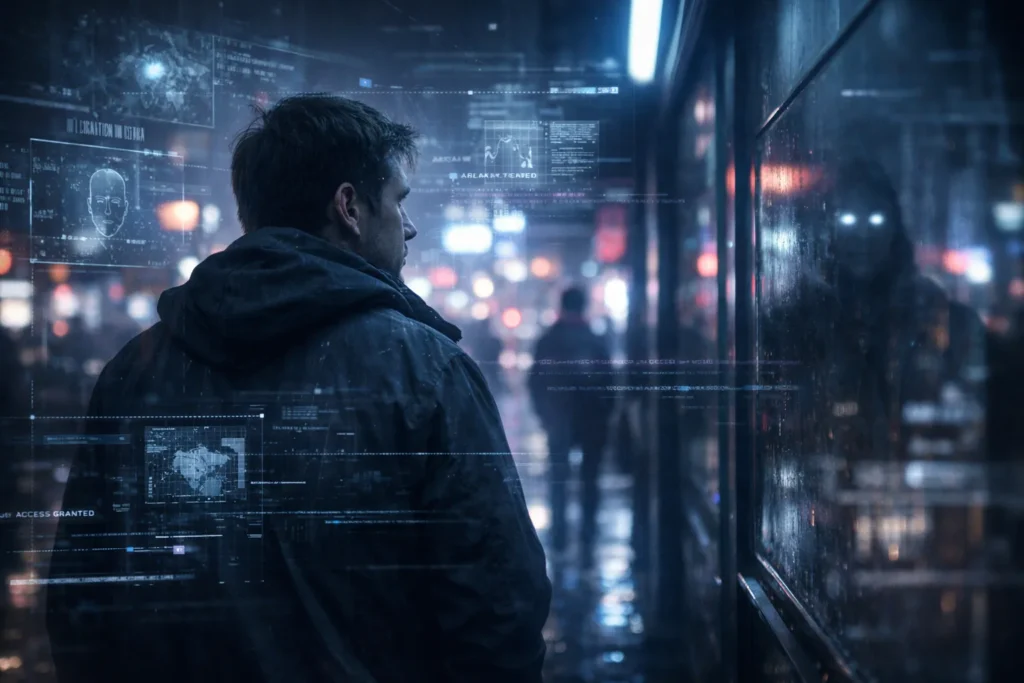

Invisible Technology: Are AI Systems Already Shaping Your Reality Without You Noticing?
Artificial Intelligence (AI) is everywhere. Machine Learning, Internet of Things, automation… all buzzwords we hear daily.
But here’s the twist: the most powerful part of this technology is no longer visible.
It doesn’t ask for attention anymore.
It just… operates in the background.
And there’s one detail that changes everything about how you see this — we’ll get there in a moment.
What science says
Let’s strip away the hype.
There’s nothing mystical about “invisible technology.” It’s a design principle.
Systems are built to operate without requiring conscious interaction.
And this is already happening across multiple layers:
- AI: curating content, filtering information, optimizing decisions
- Machine Learning: adapting based on your behavior patterns
- Automation / Hyperautomation: executing workflows without human input
- Internet of Things (IoT): devices communicating silently in networks
Simple example?
Your phone predicting what you’ll type next.
More advanced?
Financial systems detecting fraud in milliseconds using pattern recognition.
These systems don’t ask for permission in real time — they act based on probability.
And here’s the key insight:
The better the system works, the less you notice it exists.
But that leads to a deeper question… if you don’t see the system, how much of your reality is being filtered?
Historical and technological context
Technology has always followed a predictable path.
First, it’s obvious.
Then, it becomes essential.
Finally… it disappears.
- Computers → from room-sized machines to invisible cloud computing
- Internet → from dial-up noise to always-on infrastructure
- Mobile devices → from tools to extensions of human cognition
Now layer in modern systems:
- Blockchain quietly validating transactions
- Quantum computing being developed to solve problems we can’t intuitively grasp
- Augmented Reality (AR) blending digital layers into physical space
- Virtual Reality (VR) reshaping perception environments
- Synthetic Biology programming biological systems like software
This isn’t futuristic speculation.
It’s ongoing research and deployment.
Technology is shifting from tools you use… to systems that anticipate you.
Think about streaming platforms.
You don’t search anymore.
You scroll what’s already chosen for you.
But here’s the uncomfortable layer… if systems anticipate your choices, are they still your choices?
What this means today
You are not just using technology.
You are living inside an adaptive system.
And no — this is not about control or conspiracy.
It’s about influence.
Continuous, data-driven influence.
Let’s break it down:
- Content feeds prioritize what keeps you engaged
- Algorithms decide visibility and relevance
- Automated systems evaluate credit, risk, and behavior
All based on data.
Your data.
And here’s the critical shift:
You don’t see the decision-making process.
You only experience the outcome.
It’s like playing a game where the rules update in real time… but you never see the patch notes.
This creates a paradox:
- Convenience increases
- Awareness decreases
You gain efficiency… but lose visibility.
So the real question isn’t “Is this happening?”
It’s:
“How much of your daily experience is being subtly optimized without you noticing?”
My personal take
I’ll be blunt.
The most fascinating part isn’t the technology.
It’s how quickly we adapt to it.
We normalize everything.
Fast.
We trade friction for convenience without hesitation.
And honestly? That’s human nature.
But here’s the subtle cost:
- Decisions get outsourced
- Patterns get reinforced
- Curiosity gets filtered
Technology doesn’t need to control anything.
It just needs to be useful enough that you stop questioning it.
And right now… it is.
But let’s ground this properly:
There is no evidence of hidden control systems.
There is no proof of extraordinary hidden agendas.
The scientific consensus remains valid.
What we are seeing is advanced optimization at scale.
And humans… adjusting in real time.
But there’s still one layer most people ignore — and it might be the most important one.
Conclusion
Invisible technology isn’t science fiction.
It’s the natural endpoint of efficiency.
When something works perfectly… it disappears.
That’s the goal.
That’s the design.
And that’s exactly where we are heading.
This can be incredibly powerful.
It can also be quietly transformative.
The point isn’t fear.
It’s awareness.
Because in the end…
the real question is no longer what technology does for you.
It’s:
“What is it already doing… before you even realize you needed it?”
And maybe that’s the loop we haven’t fully closed yet.
FAQ
1. What is invisible technology in simple terms?
It refers to systems like AI, automation, and IoT that operate in the background without requiring direct user interaction.
2. Is there a real risk associated with it?
The main concern is not control, but subtle influence and reduced awareness of how decisions are shaped by algorithms.
3. Is this a recent phenomenon?
No. It’s part of a long-term evolution where technology becomes more integrated, automated, and less noticeable over time.